


Signs of a Hidden Water Leak: How to Protect Your Miami Home from Costly Damage
Did you know the average household leak wastes nearly 10,000 gallons of water every single year? In Miami, where water rates increased by 3.5% on October 1, 2025, those silent drips are more than just a minor annoyance. They're a direct hit to your monthly budget. You're likely here because your utility bill spiked for no clear reason, or you've noticed a musty smell that won't go away in our South Florida humidity. It's natural to feel anxious about black mold growing behind your walls or the potential cost of a slab leak repair.
We understand that stress. You need to know exactly what's happening under your floors or behind your drywall before the damage gets worse. This guide reveals the subtle signs of a hidden water leak and teaches you how to stop structural issues in their tracks. You'll learn how to confirm a leak exists, how modern technology locates pipes without tearing up your home, and how to find a dependable 24/7 Miami plumber who can help right now. Let's protect your property and your peace of mind.
Key Takeaways
- Learn why Miami's humidity makes repairing a leak within 48 hours vital to stop mold growth.
- Recognize the seven primary signs of a hidden water leak, such as wall stains or localized warm spots.
- Master the DIY meter test to confirm if you have an active leak before calling a professional.
- See how non-invasive tools find the exact source without tearing up your property.
What Is a Hidden Water Leak and Why Is It Dangerous in Miami?
In Miami, we face a unique challenge often called the "Miami Factor." Our ambient humidity stays high year-round. When you add a concealed water source to that humid environment, you create the perfect breeding ground for mold. In South Florida, mold can begin colonizing surfaces within 24 to 48 hours of exposure. If you wait for a wall to turn soft before calling for help, you're likely dealing with a full-scale remediation project rather than a simple pipe repair. Beyond the physical damage, neglecting these issues can jeopardize your home value and even your insurance claim eligibility, as many policies require homeowners to take immediate action to mitigate damage. For homeowners in the Florida Panhandle dealing with similar moisture-related concerns, the Emerald Coast Window Authority offers expert guidance on finding specialists to help secure your home's exterior integrity.
The True Cost of a Delayed Repair
A single pinhole leak in a pressurized line can waste as much as 10,000 gallons of water in a single month. This volume of water doesn't just vanish; it saturates your home's structural components. Beyond the financial hit of a massive water bill, you have to consider the dangers of water damage to your home's integrity. Constant moisture weakens wood framing and can even erode the porous limestone foundations common in Miami-Dade. This creates a soft, unstable environment that invites pests and triggers serious respiratory health issues for your family due to hidden dampness.
Why Miami Homes Are Uniquely Vulnerable
South Florida properties sit on a high water table and shifting, sandy soil. This constant movement puts physical stress on your plumbing system, leading to cracks in underground lines. If your home was built before 1975, you're at an even higher risk. Many of these older properties still rely on original plumbing that is now reaching the end of its lifespan. We frequently see homeowners who eventually require cast iron pipe replacement in Miami because these materials have corroded from the inside out. Recognizing the early signs of a hidden water leak is your first line of defense against a total system failure.
7 Primary Signs of a Hidden Water Leak in Your Home
How do you identify a plumbing crisis when the source is buried deep within your walls? While a dripping faucet is an obvious nuisance, the most dangerous signs of a hidden water leak are often subtle and easy to overlook. In both residential and commercial properties, these leaks typically fall into two categories: minor fixture issues and catastrophic supply line failures. If you see water actively gushing from a light fixture or experience a total loss of water pressure, you need emergency plumbing in Miami right now. For more concealed problems, you must rely on a combination of visual, auditory, and tactile clues to protect your property.
Visual Red Flags: Stains and Surface Changes
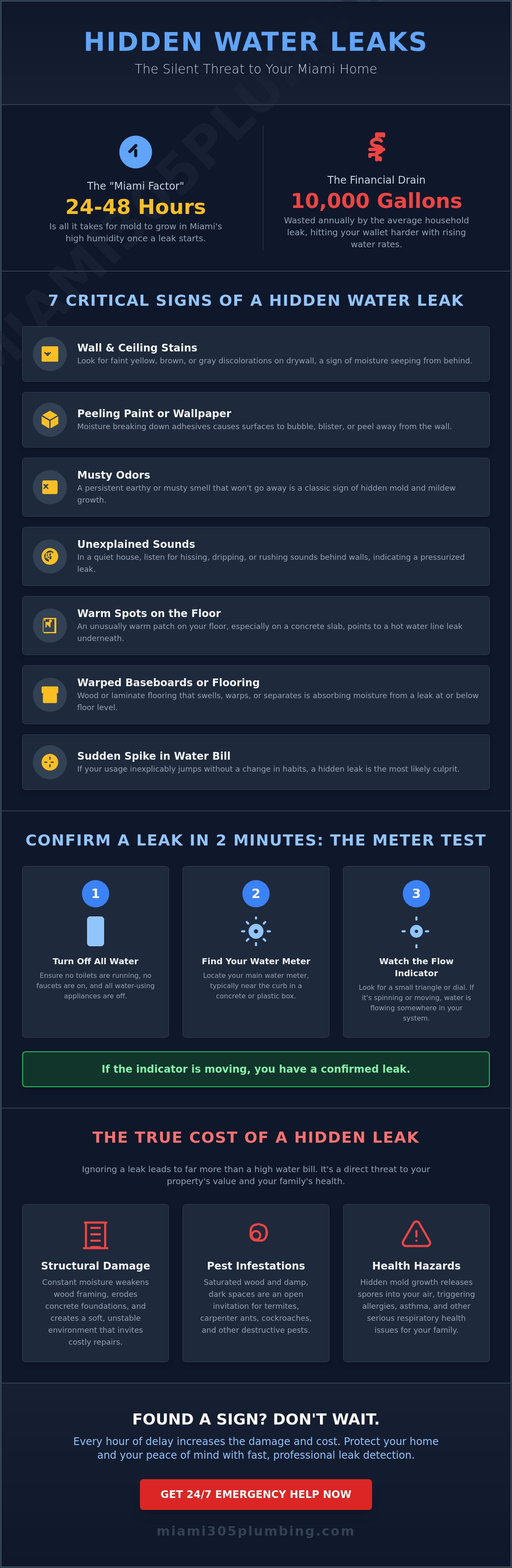
Water always leaves a trail. Look for "ghost" stains, which appear as faint yellow, brown, or gray discolorations on your drywall or ceilings. These marks indicate that moisture is saturating the material from the inside out. If the damage is concentrated on the top floor, it may be a roofing issue rather than a pipe, and professionals like United Roofing & More! can determine if a replacement is necessary. Paint that begins to bubble or wallpaper that peels away in a dry room is another major warning sign. This happens because water is breaking down the adhesive bond behind the surface. Recognizing these visual signs of a hidden water leak early can save you thousands in remediation costs. On the ground level, pay close attention to your baseboards. If they appear warped, swollen, or disconnected from the wall, you are likely dealing with a slab leak or a pipe burst at the foundation level.
Sensory Warnings: Odors and Sounds
Your senses are often more accurate than your eyes. A persistent, musty odor that lingers even after a deep cleaning is a classic indicator of hidden dampness and early mold growth. Silence the house by turning off all appliances, including the AC and dishwasher. If you still hear the sound of rushing water or a steady drip, a line has failed. Listen carefully for a faint "hissing" sound behind your bathroom or kitchen walls; this often signals a high-pressure pinhole leak. To verify if water is escaping your system, you should check your water meter. If the flow indicator is moving while all valves are closed, you have a confirmed leak.
Tactile Indicators: Hot Spots and Damp Carpets
Physical changes in your flooring can pinpoint a leak's exact location. If you walk across a tile or linoleum floor and feel a localized "hot spot," you likely have a hot water line leaking beneath the concrete slab. In carpeted areas, look for unexplained damp patches or areas where the fibers feel greasy or discolored. Hardwood flooring provides a different clue; it will often feel "spongy" or develop soft spots when the subfloor becomes saturated. If you notice these physical changes, it's wise to consult a plumbing professional before the rot spreads to your home's structural framing.
The Data Trail: Using Your Bill and Meter to Spot Leaks
Your senses can sometimes deceive you, but your water meter never lies. If you suspect a problem, the most reliable way to confirm it's real is by looking at the hard data your plumbing system provides. In Miami-Dade, where water rates saw a 3.5% increase on October 1, 2025, even a small discrepancy in your usage can lead to a significant financial burden. Looking for signs of a hidden water leak through your utility data is the best way to move from guessing to knowing.
How to Perform a DIY Water Meter Test
This simple test is the gold standard for confirming a leak. It requires no tools and only a few hours of your time. Follow these steps precisely to get an accurate result:
- Step 1: Turn off every water-using appliance and faucet in your home. This includes your ice maker, dishwasher, and irrigation system.
- Step 2: Locate your water meter. In most Miami neighborhoods, it's in a concrete or plastic box near the street. Record the current reading exactly.
- Step 3: Wait for at least two hours without using any water. Don't even flush a toilet during this window.
- Step 4: Check the reading again. If the numbers have moved, or if the small triangular flow indicator is spinning, you have a confirmed hidden leak.
The EPA offers additional tips for finding leaks if your meter test comes back positive but you aren't sure where the water is going. Once you've confirmed the issue, professional water leak detection in Miami is your next step to pinpoint the exact location without digging up your yard. If the meter is spinning rapidly, you should reach out for professional help immediately to prevent flooding.
Decoding Your Monthly Water Bill
Don't just look at the total amount due. Look at the consumption history. A sudden spike in usage usually indicates a major pipe failure or a slab leak. A gradual creep, where your usage increases slightly every month for half a year, often points to a pinhole leak or a degrading fixture. Compare your current usage to the same month from the previous year to account for seasonal changes in irrigation or pool filling.
Common Locations for Concealed Leaks in Miami Properties
Plumbing failures don't happen in a vacuum. They occur in specific "hiding spots" dictated by the age of your neighborhood and the style of your home's construction. In newer Kendall developments, we frequently see failures in kitchen island plumbing. Because these islands are often isolated from main walls, their supply lines run deep under the floor. In contrast, the historic canopy of Coral Gables presents a different threat; massive tree roots can easily crush or penetrate outdoor supply lines, leading to foundation instability. Pinpointing these issues requires specialized water leak detection in Miami to avoid unnecessary property damage.
The Dreaded Slab Leak
A slab leak occurs when a copper or PEX supply line breaks beneath your home's concrete foundation. This is a common crisis in South Florida because our sandy soil is constantly shifting. As the ground moves, the pipes rub against the abrasive concrete, leading to friction bursts. If you feel a warm spot on your floor or hear water running under your feet, consult our Expert Slab Leak Repair in Miami guide to understand your next steps. These leaks are particularly dangerous because they can wash away the soil supporting your home, leading to structural cracks.
Behind-the-Wall Pipe Failures
Underground Supply and Irrigation Leaks
Not all signs of a hidden water leak are found inside the house. If you notice unusually green patches of grass during a dry spell or find "sinkholes" and soft spots in your yard, your main supply line may be breached. A leaking main line is a financial drain that can also compromise your driveway or patio. If you suspect an outdoor issue, refer to our Expert Underground Water Leak Detection Services in Miami for non-invasive solutions. Finding the leak early prevents the water from undermining your foundation.
Do you suspect a leak is hiding in your walls or under your floors? Don't wait for the damage to become visible. Contact our expert Miami leak detection team today to protect your home from costly structural repairs.
Professional Leak Detection: Finding the Source Without the Mess
Modern Leak Detection Technology
We use a suite of non-invasive tools to "see" and "hear" what's happening inside your plumbing system. These methods allow us to find the source of the signs of a hidden water leak without causing additional damage to your property:
- Thermal Imaging: Our technicians use infrared cameras to detect temperature fluctuations behind your walls. Damp areas hold heat differently than dry ones, allowing us to map moisture trails in real-time.
- Acoustic Sensors: Pressurized water escaping a pipe creates a specific ultrasonic frequency. We use sensitive ground microphones to listen through concrete slabs and find the exact location of a burst.
- Tracer Gas: For complex underground systems or irrigation lines, we inject a safe, non-toxic gas into the pipes. We then use sensors to detect where the gas escapes the soil, pinpointing the breach with incredible precision.
Why Choose Miami 305 Plumbing for Detection
When a leak is active, every hour counts. We provide 24/7 emergency plumbing services because we know that water damage doesn't follow a 9-to-5 schedule. Our team is deeply rooted in the Miami-Dade community, mirroring the local dedication found at WellPlumbed, which has prioritized personal service and rapid response for homeowners since 2008. We understand the specific plumbing codes and the unique challenges of South Florida's aging infrastructure. You won't deal with an automated menu or a cold corporate script. You'll talk to a real person who understands your stress and is ready to help.
Our technicians take the time to explain the detection process and the necessary repairs. We believe in transparency and human connection. We want you to feel confident in the solution we provide. Don't wait for a small damp spot to become a major flood or a mold colony. Schedule your professional leak detection today and get the peace of mind you deserve. We are on-call and ready to protect your Miami home right now.
Protect Your Property and Peace of Mind
Stop the damage now—Call Miami 305 Plumbing for 24/7 Expert Leak Detection. Let's secure your home and stop the waste before your next bill arrives. We are ready to help you right now.
Frequently Asked Questions
How do I know if I have a slab leak or a regular pipe leak?
Will my homeowners insurance cover the cost of hidden leak detection and repair?
Can a small leak really cause black mold in a Miami home?
How much does a typical professional leak detection service cost in Miami?
What should I do immediately if I suspect a hidden water leak?
Is it possible for a water leak to be underground in my yard without me seeing it?
It is very common for main line or irrigation leaks to stay hidden underground for months. Look for unusually lush, green patches of grass or localized soft spots and "sinkholes" in your lawn. These outdoor leaks waste thousands of gallons and can eventually undermine your driveway or foundation if left unaddressed.
How long does it take for a professional to find a hidden leak?
Can I find a hidden leak myself using a DIY kit?
Consumer DIY kits are typically designed for water quality testing or finding simple toilet leaks with dye tablets. They don't have the power to see through drywall or hear through concrete foundations. Professional-grade acoustic and thermal tools are necessary to find the exact source of signs of a hidden water leak without damaging your home.


0 Comments