


Tree Roots in Sewer Line Miami: 2026 Guide to No-Dig Solutions
Did you know that Miami’s unique limestone soil actually helps aggressive tree roots exploit the tiny cracks in your aging cast iron pipes? If you are dealing with tree roots in sewer line miami homes, you aren't just fighting nature; you're fighting a ticking clock against South Florida's corrosive environment. It's frustrating to watch your drains slow down again just weeks after a plumber cleared them. You deserve a solution that doesn't involve a backhoe sitting on your pristine driveway or tearing up your expensive landscaping.
We understand the stress of recurring backups and the conflicting advice about chemical versus mechanical root removal. You want a permanent fix that respects your property and your time. This 2026 guide explains how to stop these roots for good using modern no-dig technology and specialized local expertise. We will walk you through the latest trenchless repair methods, show you why traditional digging is often unnecessary, and help you choose the right path for a root-free future. It is time to get your plumbing back on track with a local team that understands the specific needs of our community.
Key Takeaways
- Understand how Miami’s unique oolitic limestone soil accelerates root growth and creates structural vulnerabilities in older sewer pipes.
- Identify the critical warning signs of root intrusion, including gurgling toilets and the deceptive "green patch" myth in your landscaping.
- Learn the most effective ways to stop tree roots in sewer line miami properties using modern no-dig technology that saves your driveway.
- Discover why hydro jetting is a superior first step for clearing blockages compared to traditional mechanical snaking.
- Explore how CIPP lining creates a permanent, root-proof barrier inside your existing pipes to prevent future plumbing emergencies.
Why Tree Roots are the #1 Threat to Miami Sewer Lines
In Miami, tree roots aren't just a nuisance; they are biological drills. They seek out the moisture and nutrients inside your pipes with surgical precision. This process, known as Root invasion, begins when microscopic root hairs detect tiny vapor leaks from aging pipe joints. Once inside, they expand rapidly, eventually shattering cast iron or clay pipes from the inside out. If you're dealing with tree roots in sewer line miami homes, you're fighting a battle against nature's most persistent scavengers.
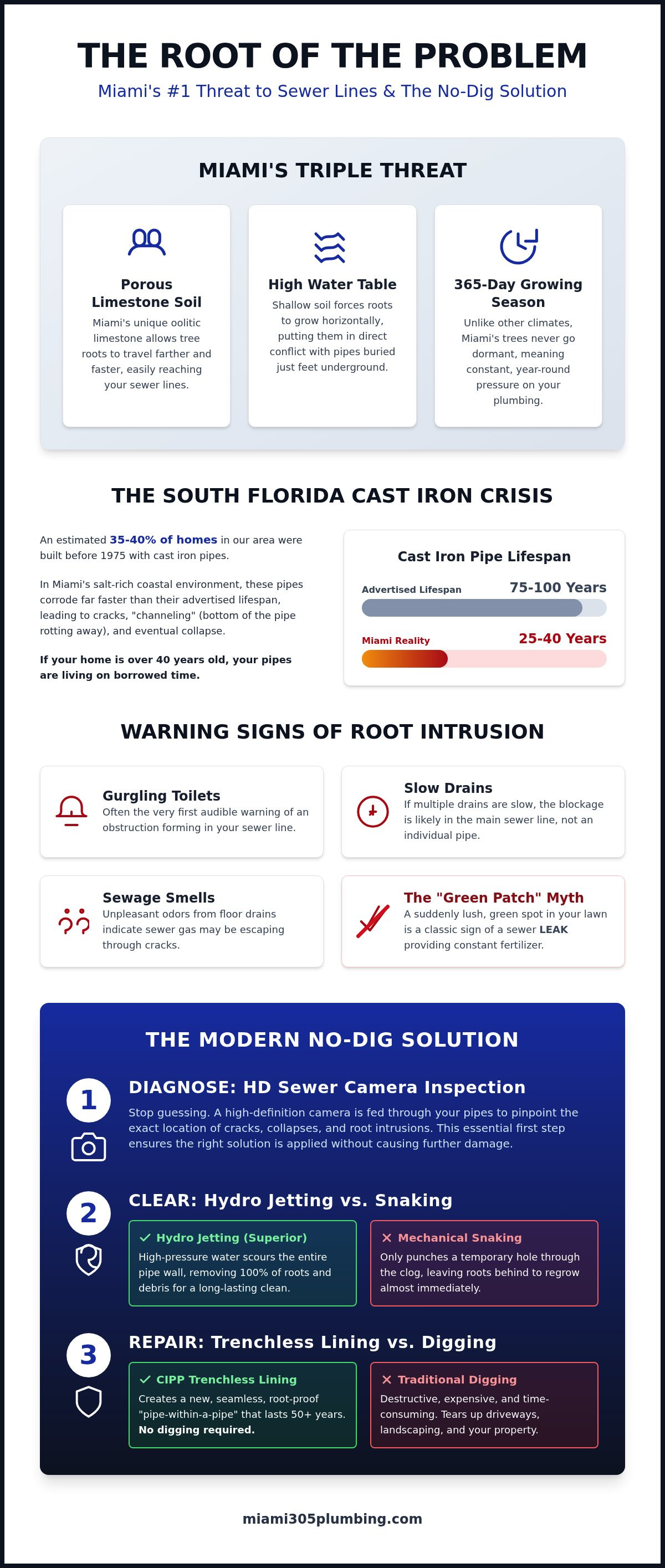
Our local geology makes this problem worse. Miami is built on porous oolitic limestone. This rocky substrate allows roots to travel further and faster than they would in heavy clay or dense soil. Additionally, our high water table forces roots to stay relatively shallow. This puts them in direct contact with your sewer laterals, which are usually buried just a few feet underground. When roots find a pipe, they don't just block it; they use it as a permanent water source.
Certain local trees are notorious "sewer killers." The Ficus, Banyan, and Royal Poinciana are the primary suspects in most local backups. These species have incredibly aggressive root systems designed to find water at any cost. If you have one of these near your home, you likely already have tree roots in sewer line miami pipes causing hidden damage. These trees can send roots dozens of feet away from their trunks to find a single hairline crack in your plumbing.
The Year-Round Growing Season in South Florida
Unlike other parts of the country, Miami's tropical climate means trees never go dormant. Your pipes never get a "break" from constant root pressure because the growing season lasts 365 days a year. Tropical downpours trigger aggressive root expansion into sewer joints as trees rush to soak up every drop of available moisture. This constant activity accelerates the failure of older plumbing systems across the county.
Neighborhoods at Highest Risk
If you live in Coral Gables, Coconut Grove, or South Miami, your risk is significantly higher due to aging infrastructure. These historic areas often feature original cast iron pipes that have reached the end of their 50-year lifespan. Similarly, the lush, mature landscaping in Pinecrest correlates with high sewer repair needs. In these neighborhoods, massive oaks and tropical hardwoods constantly compete for space with underground utilities, making professional inspections a necessity rather than a luxury.
Signs of Root Intrusion and the South Florida Cast Iron Crisis
Is your toilet making a strange gurgling sound after you flush? This is often the first warning of tree roots in sewer line miami homes. You might also notice slow drains or a faint, unpleasant sewage smell around your floor drains. Don't ignore these signs. A common myth is that a lush, vibrant green patch of grass in your lawn is a sign of healthy soil. In Miami, it's usually the opposite. That "green patch" often indicates a sewer leak where roots have found a constant supply of fertilizer and water.
Many older homes suffer from "channeling." This happens when the bottom of a cast iron pipe corrodes away over decades, leaving a jagged opening directly in the soil. Roots enter through these channels with ease. While some homeowners try chemical root killers, these are usually just temporary bandages. They create "soft blockages" by killing the immediate root mass but do nothing to fix the structural hole in your pipe. To truly solve the problem, you need to look into trenchless rehabilitation technology to seal the breach permanently.
Why Cast Iron Pipes Fail in the 305
Roughly 35-40% of South Florida homes were built before 1975, using cast iron for their main lines. In our salt-rich coastal environment, these pipes rarely last the 100 years promised in other climates. Saltwater intrusion accelerates corrosion, leading to cracks and total collapses as early as the 25-year mark. If your home is over 40 years old, it's time to consider cast iron pipe replacement in Miami before a backup becomes a flood.
The Importance of Sewer Camera Inspections
Stop guessing where the problem is. A high-definition sewer camera inspection is the only way to see exactly where tree roots in sewer line miami systems are entering. We feed a waterproof camera through the line to identify cracks, offsets, and root masses in real-time. This diagnostic step is essential before performing any drain cleaning in Miami. It ensures we don't accidentally damage a compromised pipe further. If you're smelling sewage or seeing slow drains, let a local expert take a look today.
Modern Solutions: Hydro Jetting and Trenchless Sewer Repair
You've identified the problem. Now you need a fix that doesn't destroy your yard. Modern technology allows us to handle tree roots in sewer line miami properties without the mess of traditional excavation. The process usually involves three distinct steps to ensure a permanent result. First, we use hydro jetting to clear the path. This isn't just a simple drain cleaning. High-pressure water blasts the roots away. According to U.S. Forest Service research on root intrusion, clearing the biomass is essential for long-term pipe health.
Once the line is clear, we use Cured-In-Place Pipe (CIPP) lining. This creates a "pipe within a pipe" by inserting an epoxy-saturated liner into the existing line. Roots cannot penetrate the seamless epoxy. If the original pipe is too damaged for lining, we use pipe bursting. This method pulls a new HDPE pipe through the old one, breaking the old pipe apart as it goes. These modern epoxy liners are rated to last for over 50 years against future root intrusion. You get a brand-new sewer system without the structural damage of a trench.
Hydro Jetting: The Professional Root Scrubber
Standard drain snakes only punch a hole through a root mass. They leave fragments behind that grow back almost immediately. Professional hydro jetting uses 4,000+ PSI water pressure to shear roots off flush with the pipe walls. It scrubs the interior of the pipe clean without damaging the host material. This high-velocity water is the only way to prepare a pipe for a permanent trenchless liner.
Trenchless vs. Traditional: The Miami Cost Comparison
Don't just look at the plumbing bill. Traditional excavation in Miami often means destroying high-end pavers, expensive tropical sod, and mature landscaping. Restoring a custom driveway can easily double the total project cost. Trenchless methods typically take 24 to 48 hours to complete. Compare that to a full week for excavation. When you factor in the avoided restoration costs, trenchless solutions are often 30% to 50% more affordable for local homeowners. Ask our team about a no-dig solution for your property today.
Why Miami 305 Plumbing is Your 24/7 Root Removal Expert
Are you tired of talking to robots when your sewer is backing up? When a crisis hits, you need a real person on the other end of the line. At Miami 305 Plumbing, we provide a human-led dispatch system. You will speak to a real Miami plumber who understands the urgency of your situation. We specialize in resolving issues with tree roots in sewer line miami homes at any hour of the day or night. Our 24/7 emergency plumbing in Miami ensures that you never have to wait through a long weekend with a blocked main line.
We don't just clear the line and leave. Our team looks for the most non-invasive way to restore your plumbing system. This often includes our specialized tunneling services. If roots have compromised the pipes directly beneath your foundation, we can reach them without breaking your interior floors. This approach saves your home from the dust, noise, and destruction of traditional indoor excavation. It is about providing a permanent fix with the least amount of stress for your family.
Expertise in Complex Tunneling
Tunneling is the preferred method for preserving high-end interior flooring in luxury Miami homes. Instead of jackhammering through your marble or hardwood, we excavate a precise path under the concrete slab. This allows us to perform a full sewer line replacement or repair while your family remains comfortably inside the house. We are the contractor of choice for these complex projects because we prioritize your property's integrity and value above all else.
Serving All of Miami-Dade County
Our team covers every corner of the region, from Kendall and Pinecrest to North Miami Beach and Coral Gables. We bring over 20 years of combined industry experience to every job site. We know the specific Miami-Dade plumbing codes and the unique challenges of our local limestone soil. Whether you are in a historic home or a modern estate, we have the specialized tools to handle aggressive root intrusion. Protect your property value today. Contact us for a non-invasive sewer camera inspection and get the peace of mind you deserve.
Restore Your Peace of Mind with Permanent Solutions
You don't have to live with the constant fear of a sudden sewage backup or the threat of a backhoe destroying your front yard. We've explored how Miami’s unique limestone soil and high water table accelerate pipe failure. You now know that traditional digging is no longer your only option. By choosing modern trenchless technology, you protect your landscaping and your home's structural integrity simultaneously.
Managing tree roots in sewer line miami properties requires a specialized team that understands local codes and aging cast iron. We bring over 20 years of combined local experience to every job. Our experts specialize in no-dig tunneling and CIPP lining to provide lasting results. With our 24/7 emergency sewer response, we are always ready to help when a crisis occurs.
Don’t let tree roots destroy your home-contact Miami 305 Plumbing for a professional sewer inspection today! You can stop the cycle of recurring clogs and restore your peace of mind with a permanent, root-proof solution. We are here to help you protect your investment and keep your home running smoothly.
Frequently Asked Questions
How much does it cost to remove tree roots from a sewer line in Miami?
The total cost to remove roots depends primarily on the severity of the blockage and the method used for clearing it. Simple mechanical snaking is generally the most affordable initial option, while high-pressure hydro jetting costs more due to the specialized equipment required. You also need to factor in the cost of a sewer camera inspection to ensure the roots are completely gone and to check for structural damage. Complex cases involving heavy root masses in deep lines will naturally require more labor and time.
Will homeowners insurance in Florida cover tree root damage to my pipes?
Most standard Florida homeowners insurance policies do not cover pipe damage caused by tree roots because they classify it as a gradual maintenance issue. Coverage is typically only triggered if a root-related backup causes sudden, accidental water damage to your home's interior. It is wise to review your policy for specific "Service Line" or "Sewer Backup" endorsements. These optional riders are often the only way to get financial assistance for repairing underground utility lines on your property.
What is the best way to permanently stop roots from entering my sewer line?
Installing a Cured-In-Place Pipe (CIPP) liner is the most effective way to permanently stop tree roots in sewer line miami systems. This trenchless solution creates a seamless, structural barrier inside your existing pipe that eliminates joints and cracks. Since roots enter through these tiny gaps seeking moisture, a jointless epoxy pipe leaves them with no way to get inside. It is a one-time fix that protects your plumbing from the most aggressive tropical root systems.
Can I use copper sulfate to kill tree roots in my Miami sewer pipes?
You can use copper sulfate to kill existing roots, but it acts as a temporary bandage rather than a permanent cure. While the chemical will kill the root mass it touches, it does nothing to repair the holes or cracks in the pipe that allowed the roots to enter. New roots will eventually find those same openings and grow back. Additionally, repeated use of harsh chemicals can accelerate the corrosion of older cast iron pipes and may negatively impact the local ecosystem.
How long does trenchless sewer pipe lining actually last?
Modern trenchless sewer pipe lining is engineered to last for 50 years or more. The epoxy resins used in the CIPP process are incredibly durable and resistant to both chemical corrosion and physical root intrusion. This longevity makes it a superior investment compared to temporary clearing methods. In Miami's unique environment, this long-term durability is essential for protecting your home against the constant pressure of a year-round growing season and corrosive soil conditions.


0 Comments