

What Is Plumbing Tunneling? The Homeowner’s Guide to Under-Slab Repair
Imagine waking up to a slab leak under your master bedroom. You're staring at your expensive hardwood floors, and a plumber says the only way to fix the pipe is to bring in a jackhammer. It's a stressful situation that feels like a nightmare. You've spent years making your house a home, and you shouldn't have to watch it get torn apart from the inside. Many homeowners wonder, what is plumbing tunneling and can it really save my foundation? You aren't alone in this confusion. About 40% of slab foundation repairs involve hidden plumbing issues, and you deserve a solution that doesn't ruin your living space.
We're here to provide the professional reassurance you need during this crisis. This guide will show you how tunneling allows for major pipe repairs without destroying your home's interior or risking structural damage. You'll discover the pros and cons of the process, see the step-by-step safety measures required by OSHA, and learn if your aging cast iron pipes make this the right choice. We'll give you the facts so you can protect your property and get your life back to normal quickly.
Key Takeaways
- Understand what is plumbing tunneling and how this surgical excavation method allows for pipe replacement without cutting through your home's interior.
- Compare tunneling against traditional slab breakouts to see which option best protects your expensive tile or hardwood flooring from dust and debris.
- Follow the 5-step repair process, beginning with advanced sewer camera inspections to map out the most efficient and least invasive path.
- Discover why Miami’s unique limestone soil and aging cast iron infrastructure make under-slab tunneling a preferred solution for long-term reliability.
- Learn the critical safety standards and backfilling techniques required to maintain your foundation’s structural integrity and prevent future settlement.
What Is Plumbing Tunneling? Defining the Non-Invasive Approach
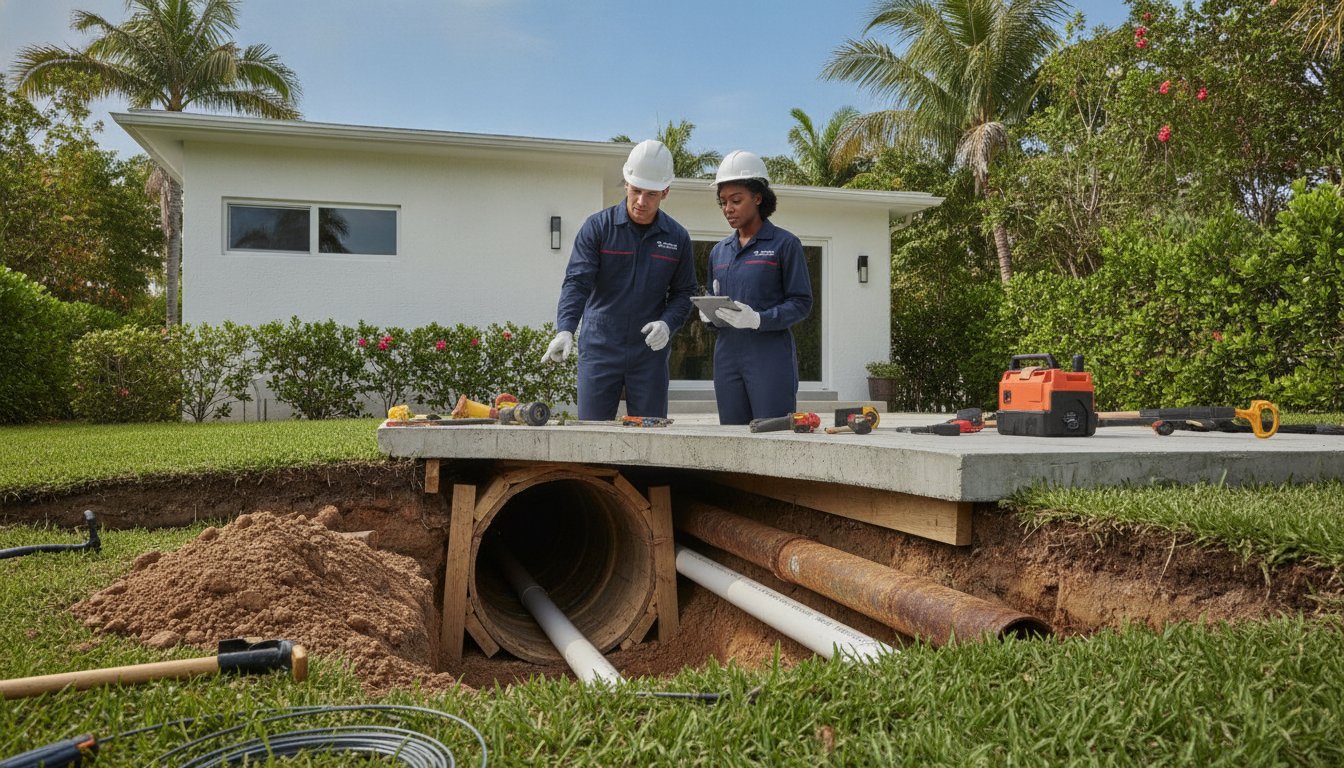
Plumbing tunneling is a strategic excavation method used to reach damaged pipes buried beneath your home's foundation. Instead of attacking the problem from above by jackhammering through your living room floor, technicians dig a path horizontally underneath the concrete slab. This technique falls under the category of trenchless technology, which focuses on repairing infrastructure with minimal surface disruption. For many homeowners, the answer to what is plumbing tunneling is simple: it's the only way to save your home's interior during a major plumbing crisis.
This process requires specialized equipment and a deep understanding of soil mechanics. It isn't just about digging a hole; it's about engineering a safe workspace that maintains the structural integrity of your slab. According to industry data from Anchor Foundation Repair, approximately 35% to 40% of all slab foundation repairs also require under-slab tunneling to address underlying pipe issues. We typically use this method for main sewer line overhauls or when water leak detection in Miami reveals multiple failure points deep under the house. By accessing the pipes from the outside, the mess stays outside.
When Is Tunneling Recommended?
We don't suggest tunneling for every small leak. It's a high-level solution for serious problems. If your home has aging infrastructure, you might eventually face cast iron pipe replacement in Miami. In these cases, the failure often spans the entire length of the house. Tunneling is the best choice if you have high-value flooring like Italian marble or hand-scraped hardwood. It's also necessary when the plumbing failure is located deep toward the center of the structure, where a traditional slab breakout would require destroying multiple rooms.
The Core Benefits of the Tunneling Method
The biggest advantage is the preservation of your daily life. You don't have to move out or live in a construction zone. There is zero disruption to your household because the work happens entirely beneath your feet. You won't have to deal with the fine concrete dust that jackhammers produce, which can settle into your HVAC system and furniture. This keeps your family safe and comfortable while we work.
- Structural Integrity: You avoid cutting the post-tension cables or rebar within your slab, which can weaken the foundation.
- Preservation: Your expensive interior finishes, custom cabinetry, and built-in features remain untouched and pristine.
- Cleanup: Post-repair costs are significantly lower because you don't have to replace flooring or repaint walls.
Tunneling vs. Slab Breakout: Which Method Is Right for You?
Choosing between a traditional slab breakout and tunneling is one of the biggest decisions you'll make during a plumbing crisis. Understanding what is plumbing tunneling helps you decide between a surgical repair and a full-scale demolition of your living space. Both methods reach the same pipes, but the impact on your home is drastically different. We believe in giving you the facts so you can choose the path that protects your investment and your peace of mind.
| Feature | Slab Breakout | Plumbing Tunneling |
|---|---|---|
| Interior Mess | High (Dust and Debris) | None (All work outside) |
| Home Use | Often requires relocation | Stay in your home |
| Restoration Cost | High (New flooring/paint) | Low (Backfill only) |
| Structural Risk | Risk to post-tension cables | Preserves concrete slab |
The "Inside-Out" Method (Traditional Slab Breakout)
A slab breakout involves using a jackhammer to cut a hole directly through your floor. This creates an incredible amount of fine concrete dust that travels through your vents and settles on every surface. While it's often the faster choice for a single leak near an exterior wall, it’s a nightmare for larger projects. You'll face the high cost of matching rare hardwood or marble tiles. Often, the new flooring won't look exactly like the old, leading to a permanent eyesore in the middle of your room.
The "Under-Home" Method (Plumbing Tunneling)
This method keeps the dirt, mud, and workers outside your home's perimeter. We dig a tunnel from the exterior, allowing our crew to replace entire sections of pipe without setting foot inside. Tunneling acts as a safeguard for your home's aesthetic value by ensuring your high-end floors and custom interiors remain undisturbed. It also protects the structural integrity of post-tension slabs. Cutting through these slabs to reach pipes can be dangerous; municipal procedures for inspecting under-slab plumbing often require engineering oversight to ensure the foundation remains stable during and after excavation.
When you calculate the total project cost, remember to include hotel stays and floor restoration for the breakout method. Tunneling might seem more involved, but it usually saves money on the back end. If you are facing a major pipe failure, speak with our local experts to see which approach fits your home’s specific foundation and your family's needs.
The 5-Step Process of Under-Slab Tunneling
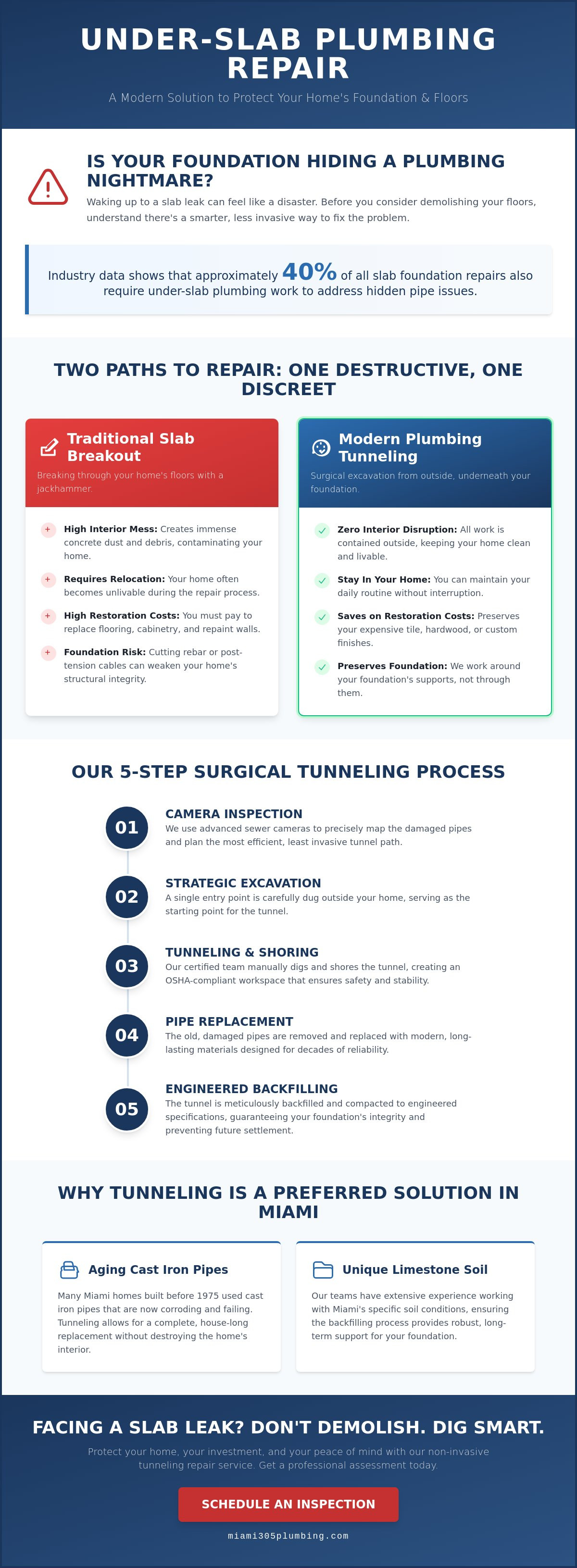
Understanding the mechanics of what is plumbing tunneling starts with seeing it as a surgical procedure for your home. We don't guess where the problem is; we use precision technology to map every inch of your underground infrastructure. This systematic approach ensures we fix the issue correctly the first time while keeping your home's interior pristine. The process follows a strict sequence to maintain safety and structural stability.
- Diagnostic Mapping: We begin with a high-definition sewer camera inspection Miami homeowners rely on to pinpoint the exact location of the leak or blockage.
- Strategic Planning: Our experts calculate the shortest, safest path under the foundation beams to minimize soil displacement.
- Precision Excavation: A specialized crew digs the tunnel, typically moving at a rate of 5 to 8 feet per day depending on soil density.
- The Plumbing Repair: Once the pipes are exposed, we perform the necessary repairs or full replacements while you continue your day inside.
- Testing and Backfilling: We verify the repair with a hydrostatic pressure test before carefully replacing and compacting the soil.
Planning and Excavation Safety
Repair and Proper Backfilling
Most projects in South Florida involve cast iron pipe replacement in Miami FL. We remove the corroded metal and install modern, durable PVC that will last for decades. After the new pipes are in place, the backfilling process begins. This is the most critical step for your foundation's future. We don't just throw the dirt back in. We use compacted soil or "flowable fill" to ensure there are no air pockets left behind. Proper compaction prevents the slab from settling or shifting later. We treat your foundation with the same care we'd give our own homes, ensuring it remains as strong as the day it was poured.
Why Miami Homes Often Require Tunneling for Pipe Repair
The Cast Iron Crisis in South Florida
Most homes in neighborhoods like Coral Gables and Pinecrest were constructed during a period when cast iron was the industry standard. These pipes have a functional lifespan of roughly 40 to 50 years. Today, those systems are reaching the point of total failure. Florida’s acidic, moist soil accelerates the oxidation of cast iron, leading to "bottoming out" where the lower half of the pipe completely dissolves into the ground. Tunneling allows us to perform a whole-house repipe from the outside. You won't have to pack your bags or move into a hotel while we modernize your home's drainage system. Even if you aren't dealing with a slab leak, it's vital to explore Septic System Pumping if you use an onsite system, as proper maintenance prevents the kind of pressure buildup that leads to pipe failure.
Geological Challenges: Limestone and Sand
Digging in Miami isn't like digging in the Midwest. We often encounter "Coral Rock," a dense limestone that requires specialized tools and experienced hands. In areas like Kendall and Palmetto Bay, managing soil stability is a constant concern due to high moisture levels. This makes precision planning essential. We never start an excavation without performing professional water leak detection in Miami FL to confirm the exact location of the damage. Identifying the problem area before we dig saves time and prevents unnecessary displacement of the limestone shelf supporting your foundation.
Navigating Miami-Dade building codes is another critical layer of the process. Local regulations are strict regarding under-slab work to ensure homes remain hurricane-ready and structurally sound. We handle the permitting and inspections required by the county so you don't have to worry about legal headaches. Every tunnel we dig meets or exceeds municipal safety standards for depth, width, and support. If you suspect your older pipes are failing, contact our local Miami experts for a professional evaluation of your home’s infrastructure.
Is Tunneling Safe for Your Foundation? Mitigating Risks
Structural Integrity and Engineering
Choosing a Specialized Miami Tunneling Expert
Before you sign a contract, ask these essential questions:
- Do you have specific insurance coverage for under-slab excavation?
- What is your process for soil compaction and void filling?
- Will you handle the necessary permits and engineering inspections?
- How many tunnels have you successfully completed in the Miami area?
Your home is likely your largest investment. Don't leave its structural health to chance or unverified workers. If you suspect a major leak or pipe failure, contact Miami 305 Plumbing for a professional under-slab evaluation. We provide the expert oversight and reliable service you need to fix your pipes without risking your foundation. Call us today for a direct solution to your plumbing crisis.
Protect Your Miami Home with Precision Repairs
Don't let a hidden pipe failure destroy your peace of mind or your beautiful interior. You now understand what is plumbing tunneling and how it serves as a surgical, non-invasive alternative to traditional slab breakouts. By choosing this method, you preserve your high-end flooring, maintain your foundation's structural integrity, and avoid the massive cleanup costs associated with interior demolition. It's the most reliable way to address aging cast iron without moving your family out of the house. For homeowners also looking to maintain or upgrade their home's outward appearance, Metro Reconstruction Services, Inc. offers a comprehensive guide on high-performance stucco textures and exterior finishes.
We're here to help you navigate this crisis with confidence. Our team brings over 20 years of combined local experience to every project. We specialize in non-invasive tunneling and cast iron replacement, providing 24/7 emergency response across all of Miami-Dade. You don't have to face this alone. We'll ensure your home stays strong and your plumbing works perfectly.
Take the first step toward a permanent solution. Schedule Your Under-Slab Inspection with Miami 305 Plumbing Today. We're ready to provide the professional reassurance and expert results you deserve.
Frequently Asked Questions
Is plumbing tunneling more expensive than cutting through the slab?
The upfront cost for excavation is generally higher, but the total project cost is often lower when you consider restoration. A traditional slab breakout requires you to replace expensive flooring, repair cabinetry, and potentially pay for hotel stays. When you weigh the total investment, what is plumbing tunneling becomes the more cost-effective choice for preserving your home's luxury finishes and avoiding interior demolition mess.
How long does a typical plumbing tunneling project take in Miami?
Most under-slab projects in South Florida take between 3 to 5 days to finish from start to finish. A professional crew can usually excavate 5 to 8 feet per day depending on the density of the limestone or coral rock beneath your home. This timeline includes the diagnostic phase, the actual pipe replacement, and the critical backfilling process to ensure your foundation is fully supported.
Will tunneling under my house void my foundation warranty?
Professional tunneling is widely accepted by warranty providers because it doesn't involve cutting structural beams or post-tension cables. Most foundation warranties remain intact as long as the work is performed by licensed experts who pull the required municipal permits. You should always notify your warranty company and provide them with the engineering and permit documentation once the repair is completed.
How do I know if I have a leak under my concrete slab?
What happens if the tunnel is not filled back properly?
Improper backfilling can lead to soil settlement and foundation cracks months after the repair is done. If air pockets are left behind, your concrete slab loses the support it needs to stay level. This is why we prioritize high-pressure soil compaction or the use of flowable fill to ensure the void is completely stabilized and your home's structural integrity is maintained.
Can I stay in my house while the plumbing tunneling is being done?
Yes, you can stay in your home and maintain your normal routine throughout the entire repair. Since all the digging and plumbing work happens from the outside, there is no worker traffic, dust, or noise inside your living space. Your water service will typically only be interrupted for a few hours during the final pipe connection, making this the least disruptive repair method.
Does homeowners insurance cover the cost of tunneling for plumbing repairs?
Many policies cover the cost of "access" to reach a broken pipe if the leak caused sudden and accidental water damage to your home. While the insurance company rarely pays for the actual pipe repair, they often cover the excavation needed to reach it. You should consult with your agent to see if your specific policy includes coverage for under-slab access in Miami-Dade County.


0 Comments